
India must greatly expand its investment in technology. Indian industry must see R&D as its way of building a future based on proprietary technology. And a much more research-focused higher education system must supply the quality of talent industry needs to do just that. Countries around the world have placed great emphasis on Innovation Policy, drawing on an increasingly rich understanding of what has worked, where and why. This rich understanding needs to be part of all discourse on economic policy. CTIER was established to do just this for India.
Naushad Forbes
Co-Chairman, Forbes Marshall
Chairman, CTIER
Areas of Impact

Featured Work
Do Indian Investors Value R&D?
A common refrain of industry leaders is that Indian investors do not value R&D investments. In this brief, we aim to explore this perception and...
Do Indian Investors Value R&D?
According to India’s industry leaders, one of the reasons for their underinvestment in R&D is Indian investors. A common refrain is that Indian investors do not value R&D investments. In this brief, we aim to explore this perception and provide empirical evidence. We start by examining industrial R&D in India and its divergence from global industrial R&D. This is followed by a review of the global investor landscape and the academic literature around R&D and investor sentiment. We then highlight the IPO setting as a unique opportunity to study investor behaviour in India and our analysis of the Indian investor landscape. We conclude by looking at the questions that emerge from the data. Our findings suggest that Indian investors place limited value on the R&D activities of firms.

CTIER States Snapshot
Regional innovation ecosystems in India show significant variation across key indicators such as R&D expenditure, industrial R&D centres, startups, incubation centres...
CTIER States Snapshot
Regional innovation ecosystems in India show significant variation across key indicators such as R&D expenditure, industrial R&D centres, startups, incubation centres, and patents. While some regions perform strongly across multiple indicators, others are still developing capabilities across these dimensions. The Centre for Technology, Innovation and Economic Research (CTIER) has tracked this evolution across multiple indicators since the CTIER Handbook 2019. The CTIER States Snapshot provides a coherent understanding of where regional innovation ecosystems stand today.
CTIER Handbook 2025
India is home to some excellent institutions, high calibre talent and successful enterprises. What is missing is the full realisation of our innovation potential. Ten years ago...
CTIER Handbook 2025
India is home to some excellent institutions, high calibre talent and successful enterprises. What is missing is the full realisation of our innovation potential. Ten years ago we established CTIER to bring technical capability and innovation to the forefront of policy discussion and base it on data. We have seen modest but encouraging change since, be it in the policy space or within Indian industry.
This Handbook, now in its fourth edition, is a wealth of information and data on innovation and technology in India. Over the years it has brought together various stakeholders, including industry, government bodies and academia, to derive insights to strengthen India’s R&D and innovation ecosystem. It has helped shape academic thought in the economics of innovation. It has helped design programmatic interventions to build the capabilities needed to transform Indian industry into an innovation powerhouse.
The potential for Indian firms to lead globally in technology is real. Many of our large Indian firms are profitable by international standards; they just invest very little in R&D. For policymakers, the key imperative is to identify who should fund what research (scientific research as well as technological research) and where it is best performed, whether in industry or academia. Unlike the rest of the world, public R&D in India is mostly performed in autonomous government laboratories, which are cut off from our higher education institutes and industry. By doing much more of our public research in our higher education system, we would simultaneously train more advanced talent needed by our industry. And strong inhouse investment within industry is a precondition for taking advantage of public research.
The essays in this edition start with a comparison of data on key innovation parameters between India and the two technology giants, the US and China. In the current environment of intense competition for technology and talent, the essay serves as a reminder of the need for India to capitalise on her strengths in key sectors like pharmaceuticals & biotechnology and automobiles & parts among others, while growing her capabilities in sectors like electronic & electrical equipment. The subsequent essays focus on building a bold ambition for the pharmaceuticals & biotechnology sector and exploring and expanding opportunities in the emerging sectors of semiconductors and electric vehicles.
As before, the CTIER Handbook makes available the most current and useful data on technology and innovation in India. Companies over time tell us about progress we made. International companies tell us how far we have to go. Janak and his young team at CTIER do us all a great service by producing these excellent Handbooks.
Coinciding with our tenth anniversary, this is a special edition for the CTIER team
Events
April 2026
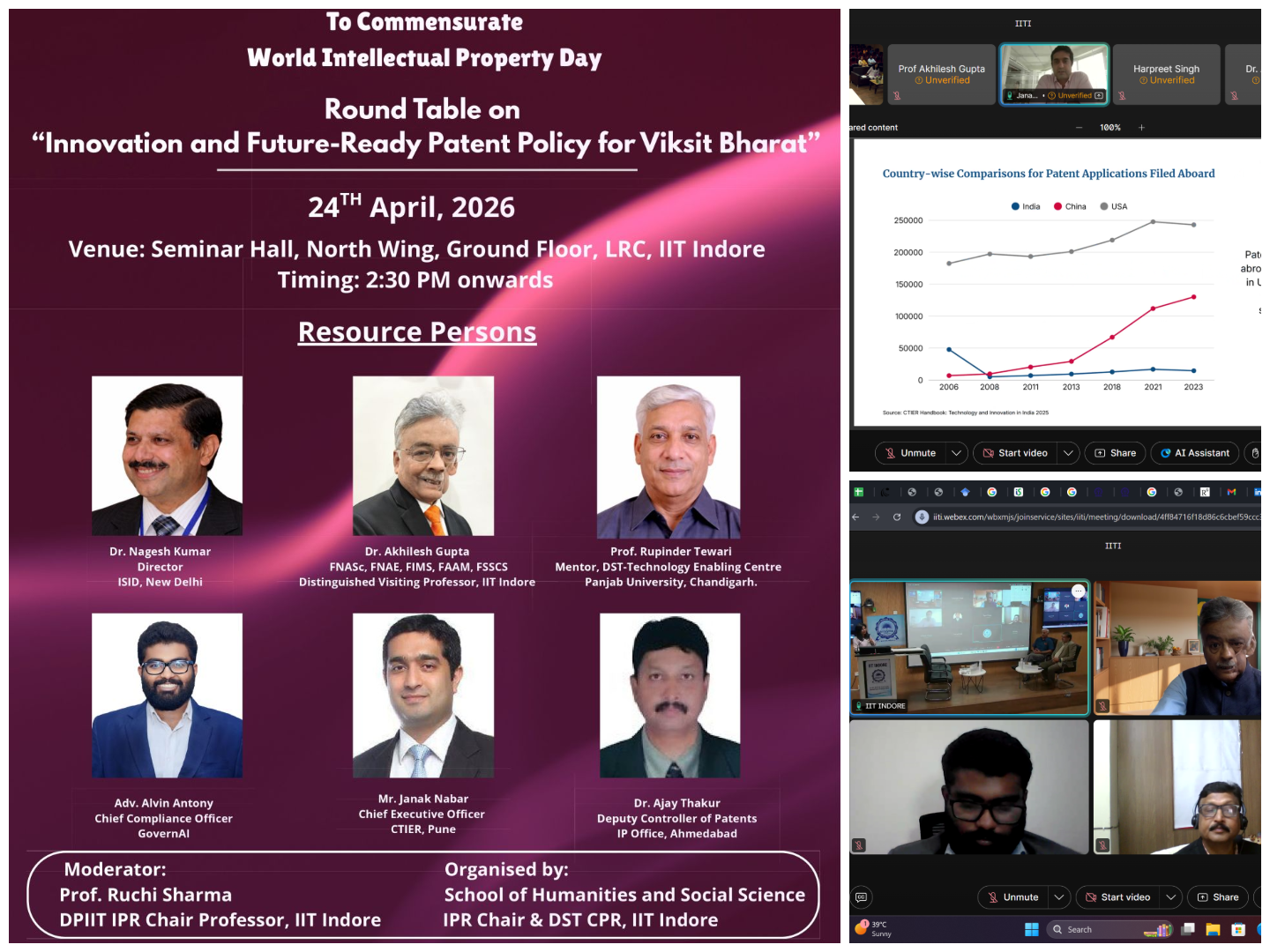
Innovation and Future-Ready Patent Policy for Viksit Bharat
Janak Nabar (CEO, CTIER) was invited to participate in a roundtable discussion on “Innovation and Future-Ready Patent Policy for Viksit Bharat”, organised by the School of Humanities and Social Science, IPR Chair & DST CPR, IIT Indore.
He presented data and insights on India’s patent landscape. This covered trends in patent applications and grants, the IP strategies of Indian firms, and the areas of product development that are driving patent activity in India.
The roundtable brought together a distinguished group of participants, including Nagesh Kumar, Dr Akhilesh Gupta, Prof Rupinder Tewari, Alvin Antony and Dr. Ajay Thakur. The discussion explored what a future-ready patent policy would need to look like to support India’s innovation ambitions. Conversations that bring together such a breadth of expertise are essential to shaping policy that is grounded in evidence and responsive to the realities of innovating firms in India.
April 2026
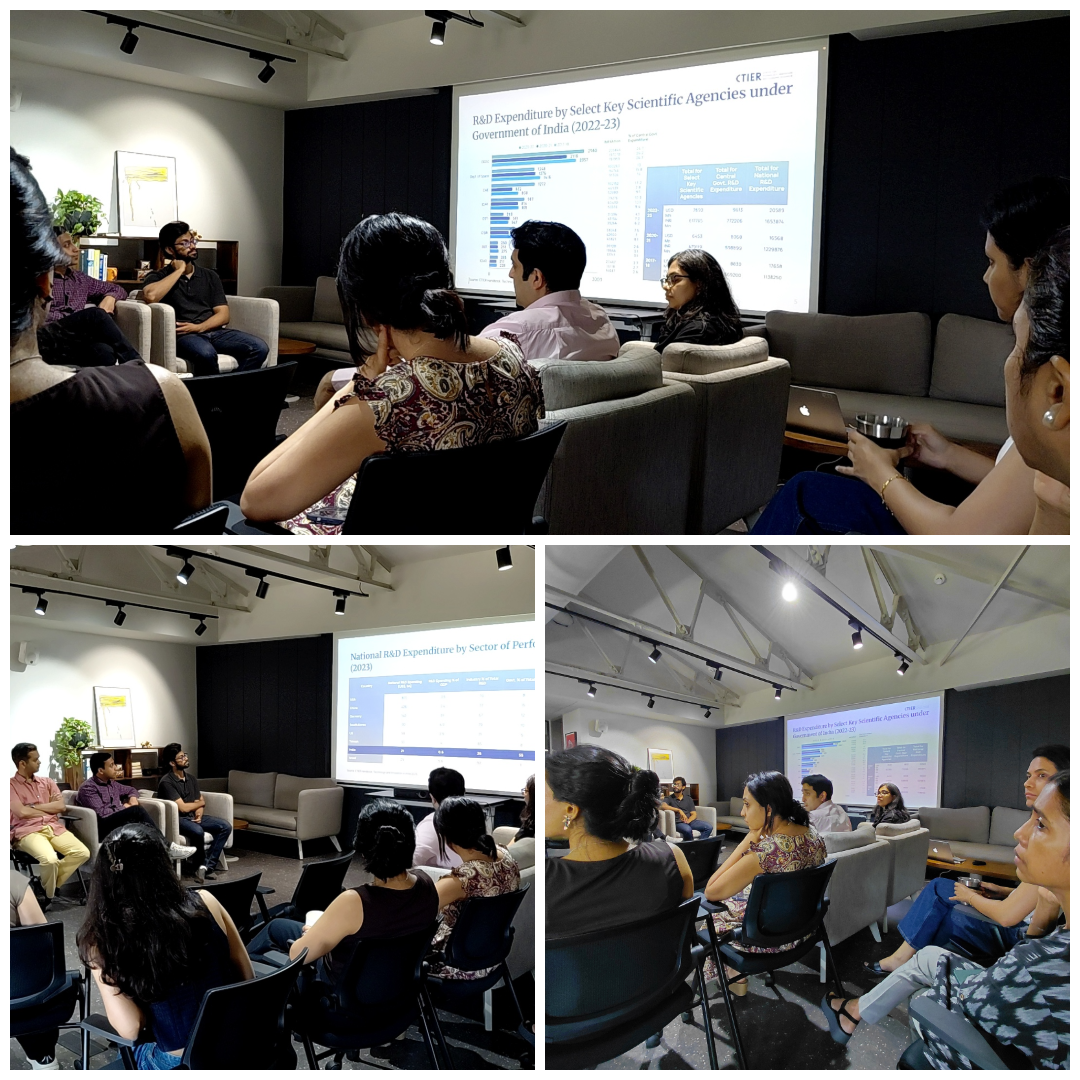
Outreach session on the CTIER Handbook: Technology and Innovation in India at Artha Global
CTIER team conducted an outreach session on the CTIER Handbook: Technology and Innovation in India at Artha Global. The session brought together a curious and engaged group of public policy thinkers for a wide-ranging conversation on some of the Handbook’s core themes.
Key data points, including R&D intensity, firm-level R&D concentration, and industrial R&D spending, were showcased. This reiterated that instead of just increasing overall R&D spending, India needs to strengthen linkages and encourage innovation-driven growth. The session also examined sectoral trends, including developments in semiconductors and their relevance for India’s technological trajectory, along with comparative insights on India’s innovation performance alongside China and the US.
The depth of questions pushed the discussion beyond the presentation and opened up valuable perspectives on India’s innovation ecosystem.
April 2026
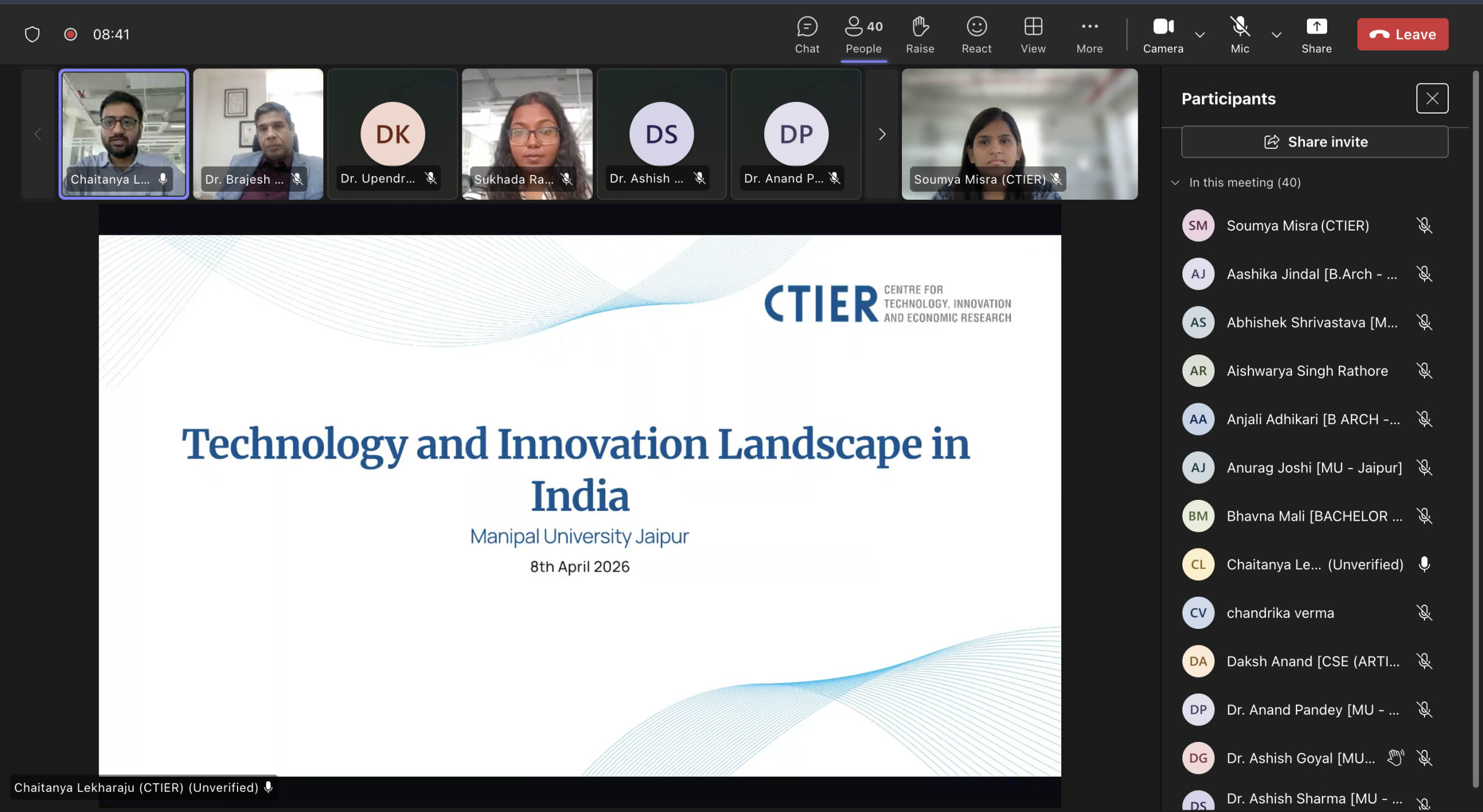
Outreach session on the CTIER Handbook: Technology and Innovation in India at Manipal University Jaipur (MUJ)
CTIER team conducted an outreach session on the CTIER Handbook: Technology and Innovation in India at Manipal University Jaipur (MUJ). The session brought together a curious and engaged group of students for a wide-ranging conversation on some of the Handbook’s core themes, from India’s innovation ecosystem and the role of industrial R&D, to the shifting dynamics of global innovation leadership.

April 2025
Principal Scientific Adviser Unveils Landmark Report on 'Evaluation of Innovation Excellence Indicators of Public Funded R&D Organizations’ (Round 2)
April 2025
Insufficient support for deep tech start-ups in India

